


The Wrong Person in the Right Role: My Leadership Mistake

Updated: May 5
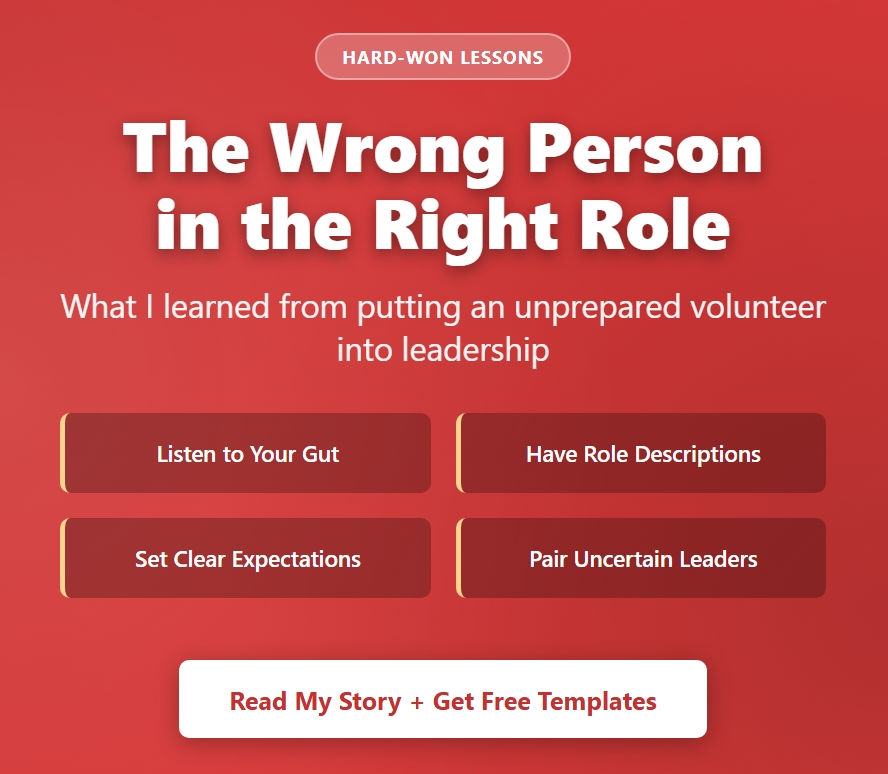
I knew it was a mistake before I said yes.
My gut was screaming "no." Every instinct told me this wasn't going to work. But I said yes anyway.
We were a couple months out from our annual Great Day of Service—an all-church initiative where 2,000 people would fan out across our community to serve at dozens of locations. Schools, nonprofits, neighborhood cleanups, home repairs for seniors—the whole city would see our church in action.
It was a massive coordination effort. Dozens of project leaders managing hundreds of volunteers. Logistics were complex. Community partners were counting on us. I needed strong leaders for every project.
And that's when I made the mistake.
═══════════════════════════════════════════════════════
THE SETUP: WHEN EAGERNESS LOOKS LIKE READINESS
A young adult from our church—let's call him Jason—approached me about leading one of the projects. Jason was enthusiastic. Passionate about serving. Loved our church. Had participated in previous service events as a volunteer. Now he wanted to step up and lead. On the surface, it looked like a natural progression: volunteer → leader.
But there was a problem.
Jason had recently experienced some significant life upheaval. Personal relationships were messy. His emotional state was fragile. I'd noticed in recent weeks that he seemed overwhelmed, reactive, and easily frustrated.
When Jason asked to lead a project, my gut immediately said: "Not right now."
But here's what my brain said:
- "We need leaders, and he's volunteering"
- "He's enthusiastic—that counts for something"
- "Maybe giving him responsibility will help him through this difficult season"
- "I don't want to discourage someone who's stepping up"
So I ignored my gut. I said yes.
I assigned Jason to lead a project coordinating volunteers at a local elementary school for a campus beautification initiative. Thirty volunteers. Relationship with school principal. Visibility in the community.
Big mistake.
═══════════════════════════════════════════════════════
THE UNRAVELING: WHEN RED FLAGS BECOME DISASTERS
The first month was fine. Jason seemed engaged. He attended the leadership meetings. He recruited volunteers. Everything looked okay. But then, about ten days before the event, things started unraveling:
- He missed a critical planning call with the school principal. When I followed up, he was defensive: "I forgot. I've had a lot going on."
- Five-six days before: he hadn't confirmed volunteer assignments or communicated details to his team. When I asked about it, he snapped: "I'll get to it."
- Three days before: the school principal called me directly. Jason had been unresponsive to her emails. She was nervous about the project.
- 48 hours before the event: I sat down with Jason to address the issues. He broke down. The stress had been too much. His personal life was falling apart. He couldn't handle leading this project.
He quit.
═══════════════════════════════════════════════════════
THE SCRAMBLE: 11TH HOUR DAMAGE CONTROL
I had to act fast. I reached out to Sarah—a seasoned volunteer coordinator who'd led projects in previous years. She graciously agreed to step in with less than 48 hours' notice.
Sarah spent the next two days:
- Calling every volunteer personally to clarify details
- Re-establishing communication with the school principal
- Reorganizing logistics Jason had left in disarray
- Calming nerves and rebuilding confidence
The event happened. The school project was successful. The principal was happy. Volunteers had a great experience.
But it could have been a disaster.
And it was entirely preventable.
The problem wasn't Jason. Jason was a good person going through a hard season. The problem was me—putting him in a role he wasn't ready for when I knew better.
═══════════════════════════════════════════════════════
WHAT I LEARNED: THE LESSONS THAT CHANGED MY LEADERSHIP
Looking back, I can identify exactly where I went wrong and what I should have done differently.
LESSON #1: LISTEN TO YOUR GUT
When every instinct says "no" but your brain rationalizes "yes"—the gut is usually right.
Why I ignored my gut:
- I needed leaders (scarcity mindset)
- I didn't want to discourage a volunteer (people-pleasing)
- I hoped responsibility would help him (savior complex)
- I rationalized that enthusiasm equals readiness (it doesn't)
What I should have done:
Trusted my instincts and said: "Jason, I appreciate your willingness to lead. But given everything you're navigating right now, I think leading a major project might add stress you don't need. How about you serve as a volunteer this time, and we'll revisit leadership when life is more stable?"
The gut test: If you're having to rationalize why someone should lead, they probably shouldn't.
LESSON #2: HAVE CLEAR ROLE DESCRIPTIONS IN PLACE
I didn't have a written job description for project leaders. If I had, Jason would have been qualified—and we both would have known it up front.
What was missing:
A clear role description would have included:
- Time commitment: 10 hours over 4 weeks, including mandatory leadership meetings
- Key responsibilities: Help recruit 30 volunteers, coordinate with school principal, manage day-of logistics
- Required competencies: Proven reliability, strong communication skills, ability to handle stress
- Etc.
With a written description, the conversation would have been different:
"Jason, here's what leading this project requires. Given what you're navigating personally, do you honestly have the bandwidth for this right now?"
He probably would have said no. Or at least, we would have had an honest conversation about readiness.
The role description test: If you can't articulate what the role requires, you can't evaluate whether someone is qualified.
LESSON #3: SET CLEAR EXPECTATIONS EARLY (AND GET AGREEMENT)
Even without a formal job description, I could have set explicit expectations and asked Jason to commit.
What I should have said:
"Jason, if you lead this project, here's what I'll need from you:
- Attend all three leadership meetings (non-negotiable)
- Respond to the school principal within 24 hours (every time)
- Recruit and confirm 30 volunteers by two weeks before the event
- Send clear communication to your team at least twice before event day
- Be present at the school 30 minutes before volunteers arrive
Can you commit to these specific expectations?"
If he hesitated or equivocated, that's my answer: He's not ready.
Setting expectations early does two things:
1. It clarifies what "yes" means. Leading isn't just showing up; it's executing specific responsibilities.
2. It gives you a framework for course-correction. If expectations aren't met, you have objective grounds to address it, not just "I have a bad feeling about this."
The expectation test: If you can't get clear agreement on specific deliverables up front, you won't get them later.
LESSON #4: PAIR QUESTIONABLE LEADERS WITH MATURE LEADERS
This is the lesson I wish I'd learned before this disaster.
Here's what I should have done:
If I felt uncertain about Jason but wanted to give him an opportunity, I should have paired him with Sarah from the start.
Structure:
- Sarah leads the project (experienced, proven leader)
- Jason serves as co-leader or assistant leader (learning role)
- Jason gets leadership experience with guardrails
- Sarah provides mentoring, accountability, and backup
This approach:
- Gives Jason growth opportunity without high risk
- Protects the project from failure
- Builds Jason's capacity for future leadership
- Creates natural mentoring relationship
Instead, I threw Jason into the deep end alone—and he nearly drowned.
The pairing test: If you wouldn't trust someone to lead alone, don't let them lead alone. Pair them with someone you would trust.
═══════════════════════════════════════════════════════
THE RED FLAGS I SHOULD HAVE SEEN (AND YOU SHOULD WATCH FOR)
Looking back, the warning signs were there before I even said yes. I just chose to ignore them.
Here are the red flags that should trigger caution when recruiting leaders for community outreach:
RED FLAG #1: RECENT MAJOR LIFE UPHEAVAL
What it looks like:
- Divorce, separation, or relationship crisis in past 6 months
- Job loss or major career change recently
- Death of close family member or friend
- Health crisis (theirs or family member's)
- Major financial crisis
- Recent move or relocation
Why it matters:
Leadership requires emotional bandwidth, consistent availability, and mental clarity. People in crisis struggle with that—and it's not their fault. It's just reality.
What to do:
Compassionately redirect: "You're navigating a lot right now. Let's have you serve in a support role this time, and we'll revisit leadership when life stabilizes."
RED FLAG #2: PATTERN OF UNRELIABILITY
What it looks like:
- Frequently cancels commitments last-minute
- Doesn't show up when they said they would
- Misses deadlines without communication
- Says "yes" to everything but follows through on little
Why it matters:
Past behavior predicts future behavior. If someone is unreliable as a volunteer, they'll be unreliable as a leader—but with more at stake.
What to do:
Build a track record first: "I'd love to see you lead in the future. Let's start with you serving consistently as a volunteer for the next 6 months, and then we'll talk about leadership."
RED FLAG #3: DEFENSIVENESS WHEN GIVEN FEEDBACK
What it looks like:
- Reacts negatively when asked questions
- Takes constructive feedback as personal attack
- Blames others when things go wrong
- Can't admit mistakes or say "I was wrong"
Why it matters:
Leaders need to receive feedback, course-correct quickly, and own problems. If someone can't do this as a volunteer, they definitely can't do it as a leader.
What to do:
Don't promote them. Defensive people become defensive leaders who damage teams and partners.
RED FLAG #4: ENTHUSIASM WITHOUT COMPETENCE
What it looks like:
- Passionate about the cause but lacks necessary skills
- Eager to serve but has no relevant experience
- Wants to lead but hasn't proven ability to follow well
- Excited about the role but doesn't understand what it requires
Why it matters:
Enthusiasm is wonderful—but it's not enough. Community outreach requires competence because community partners are depending on you.
What to do:
Channel enthusiasm toward skill-building: "I love your passion! Let's get you serving alongside an experienced leader first so you can develop the skills you'll need to lead well later."
RED FLAG #5: RELATIONAL CHAOS
What it looks like:
- Drama follows them wherever they go
- Conflicts with multiple people in the church
- Burns bridges regularly
- Talks negatively about other leaders or volunteers
Why it matters:
Community outreach is relational work. If someone can't maintain healthy relationships internally, they won't maintain them with external partners.
What to do:
Address the relational patterns before considering leadership: "I've noticed some relationship challenges. Let's work on those before adding leadership responsibility."
RED FLAG #6: "SAVIOR COMPLEX" MOTIVATION
What it looks like:
- Wants to lead to "save" or "fix" people
- Sees community members as "less than" who need rescuing
- More interested in feeling good about serving than actual impact
- Talks about "those people" with condescension
Why it matters:
Community outreach must be rooted in dignity, mutuality, and respect. A savior complex damages relationships and undermines partnerships.
What to do:
Don't put them in leadership. Ever. This mindset causes harm.
RED FLAG #7: EAGERNESS TO LEAD BEFORE PROVING FAITHFULNESS
What it looks like:
- Wants leadership role immediately
- Hasn't served consistently as volunteer first
- Jumps from church to church looking for leadership positions
- More interested in title than service
Why it matters:
"Faithful in small things" is a biblical leadership principle for a reason. If someone won't serve faithfully without a title, they won't serve faithfully with one.
What to do:
Require a track record: "Our policy is to see consistent volunteer service for at least 6-12 months before considering someone for leadership. Let's start there."
═══════════════════════════════════════════════════════
HOW TO COURSE-CORRECT GRACEFULLY (BECAUSE YOU WILL NEED TO)
Despite your best efforts, you will eventually recruit the wrong person. Here's how to course-correct without destroying the person or the project.
STEP 1: ACT QUICKLY (BUT NOT IMPULSIVELY)
When you realize someone isn't working out:
Don't wait and hope it gets better. It won't.
Don't avoid conversation because it's uncomfortable.
Don't let it drag on until the project is in crisis.
But also:
Don't fire someone via text message.
Don't react emotionally in the moment.
Don't humiliate them publicly.
The timeline:
- Notice the problem
- Gather specific examples (not just "bad feeling")
- Have private conversation within 48-72 hours
- Make decision and implement within one week
STEP 2: HAVE THE HONEST CONVERSATION
What I should have said to Jason (three weeks before the event, not 48 hours):
"Jason, I need to talk with you about the school project leadership. I've noticed [specific examples: missed call with principal, late communication to volunteers, defensive response to questions]. I'm concerned that this leadership role is adding stress you don't need right now, given everything you're navigating personally. I think the best course of action is for me to bring in Sarah to lead the project, and for you to step into a support role—or step back entirely if that's better for you. This isn't a commentary on your value or potential. It's me acknowledging that the timing isn't right. I should have been more thoughtful about this from the beginning."
Key elements of the conversation:
1. Be specific. Not "you're not working out" but "here are the specific issues I've observed."
2. Take responsibility. "I should have set clearer expectations" or "I should have recognized the timing wasn't right."
3. Focus on the situation, not the person. "This role isn't a good fit right now" not "you're not a good leader."
4. Offer dignity. Give them an out that doesn't humiliate them.
5. Be kind but firm. Compassion doesn't mean avoiding the hard decision.
STEP 3: MAKE THE LEADERSHIP CHANGE CLEAR
Internally:
Be honest with your team and other leaders (while protecting the person's dignity):
"Jason is stepping back from the school project leadership due to some personal circumstances. Sarah is taking over as project leader. Jason may serve in a support role or take this event off to focus on what he needs to focus on."
Externally:
With community partners (school principal, nonprofit director):
"There's been a change in project leadership. Sarah will be your primary contact moving forward. I apologize for any confusion during the transition."
With volunteers:
"Sarah is now leading the school project. She'll be reaching out to confirm details. Thanks for your flexibility."
Keep it brief. Keep it professional. Keep it focused on moving forward.
STEP 4: SET THE PERSON UP FOR FUTURE SUCCESS (IF POSSIBLE)
This is where grace meets wisdom.
If the person is teachable and the issue was timing/capacity:
"Jason, I'd love to see you in leadership in the future. Here's what would need to happen:
- Take the next 6 months to focus on what you need to focus on personally
- Serve as a volunteer (not leader) at our next two service events
- Demonstrate consistent follow-through on small commitments
- Then let's revisit a leadership opportunity
I'm not closing the door. I'm asking you to build a foundation first."
If the person is defensive/unteachable or has character issues:
Don't make promises you won't keep. Be honest:
"I don't think leadership in community outreach is the right fit for you right now. Let's focus on other ways you can serve and grow."
STEP 5: LEARN FROM IT
After the crisis passes, debrief:
- What red flags did I miss or ignore?
- What pressure (internal or external) caused me to compromise standards?
- What systems do I need to prevent this next time?
- How can I be more discerning in future recruitment?
I wrote down four commitments after the Jason situation: (over 20 years ago)
1. Never ignore my gut when recruiting leaders
2. Create written role descriptions before recruiting anyone
3. Require proven volunteer track record before leadership consideration
4. When uncertain, pair new leaders with experienced leaders
Those four commitments have prevented multiple similar disasters since.
═══════════════════════════════════════════════════════
THE ROLE DESCRIPTION SOLUTION: WHAT I SHOULD HAVE HAD IN PLACE
After this disaster, I created clear role descriptions for every community outreach leadership position. If I'd had these in place before Jason asked to lead, the conversation would have been completely different.
Here's what a strong role description includes:
PROJECT LEADER ROLE DESCRIPTION
(Great Day of Service - School Beautification Project)
PURPOSE:
Lead a team of 30 volunteers in partnering with ____________________ Elementary School to beautify campus and demonstrate Christ's love through service.
TIME COMMITMENT:
- 10-12 hours over 4 weeks leading up to event
- Event day: 4 hours on-site
- Total: Approximately 15 hours
KEY RESPONSIBILITIES:
Pre-Event (Weeks 1-4):
□ Attend all three mandatory project leader meetings
□ Maintain regular communication with school principal (respond within 24 hours)
□ Recruit and confirm 30 volunteers through church database and personal invitations
□ Communicate clearly with volunteer team (minimum 2 emails before event)
□ Coordinate logistics: supplies, timeline, parking, assignments
□ Submit volunteer roster to Event Coordinator 10 days before event
Event Day:
□ Arrive 30 minutes before volunteers (set up, meet principal)
□ Lead volunteer orientation (5-10 minutes)
□ Oversee project execution and troubleshoot issues
□ Thank principal and volunteers before departing
□ Submit brief project report within 48 hours
REQUIRED QUALIFICATIONS:
✓ Active church member for at least 6 months
✓ Demonstrated reliability (consistent attendance, follows through on commitments)
✓ Previous volunteer participation in at least one Great Day of Service event
✓ Strong communication skills (written and verbal)
✓ Ability to lead and motivate volunteers
✓ Flexible problem-solver who stays calm under pressure
✓ Currently emotionally and relationally stable (not in crisis)
REPORTING:
Project Leader reports to Great Day of Service Coordinator
SUPPORT PROVIDED:
- Training at three pre-event leadership meetings
- Access to volunteer recruitment tools and templates
- Event Coordinator available for questions and troubleshooting
- Possible pairing with co-leader or assistant leader if needed
COMMITMENT:
I, _________________________, commit to fulfill the responsibilities outlined above to the best of my ability. I understand that if I cannot meet these expectations, I will communicate immediately with the Event Coordinator.
Signature: _________________________ Date: _____________
─────────────────────────────────────────────────────────────────
If Jason had seen this role description, two things would have happened:
1. He might have self-selected out. Seeing "currently emotionally and relationally stable" and recognizing he wasn't, he might have said, "This isn't the right time."
2. I would have had objective grounds to say no. Instead of just "my gut says no," I could have pointed to specific qualifications he didn't meet.
Role descriptions aren't bureaucratic. They're protective—for you, for them, and for the project.
═══════════════════════════════════════════════════════
WHAT THIS MEANS FOR YOUR COMMUNITY OUTREACH LEADERSHIP
Here's what I want you to take away from my mistake:
1. YOUR GUT IS OFTEN WISER THAN YOUR NEED
When you desperately need leaders, you'll rationalize questionable choices. Don't. Scarcity causes compromise, and compromise causes crisis. If your gut says no, listen to it.
2. WRITTEN ROLE DESCRIPTIONS PROTECT EVERYONE
They clarify expectations, provide objective criteria, and prevent awkward conversations later.
You don't need elaborate job descriptions—just clear answers to:
- What does this role require? (time, skills, responsibilities)
- What qualifications are necessary?
- What are the disqualifiers?
3. TRACK RECORD MATTERS MORE THAN ENTHUSIASM
Enthusiasm is wonderful. But "faithful in small things" is the biblical leadership qualifier for a reason. Don't promote someone to leadership who hasn't proven faithfulness as a volunteer.
4. PAIRING REDUCES RISK WHILE DEVELOPING CAPACITY
If you're uncertain about someone but want to give them opportunity, don't give them solo leadership. Pair them with someone proven. This protects the project while developing the person.
5. COURSE-CORRECTING ISN'T CRUEL—IT'S RESPONSIBLE
When you realize you've made a mistake, fix it quickly and gracefully. Letting someone fail publicly because you're afraid to have a hard conversation isn't kindness—it's cowardice.
6. COMMUNITY PARTNERS DESERVE YOUR BEST LEADERS
This is ultimately about stewardship. When you put unreliable, unprepared, or emotionally unstable people in leadership of community partnerships, you damage relationships that took years to build. Your community partners deserve leaders who will honor them and follow through.
═══════════════════════════════════════════════════════
DISCUSSION QUESTIONS
1. Have you ever recruited the wrong person for a role? What red flags did you miss or ignore? What did you learn?
2. What makes it hard for you to say "no" to eager volunteers who ask to lead? Need? People-pleasing? Conflict avoidance?
3. Do you have written role descriptions for your community outreach leadership positions? If not, what's preventing you from creating them?
4. When your gut says "no" but you can't articulate why, do you trust it or ignore it? What's been the result?
5. Have you ever had to remove someone from a leadership role? How did you handle it? What would you do differently?
═══════════════════════════════════════════════════════
WANT TO GO DEEPER?
This blog post draws from Beyond the Walls: Building Your Foundation (Book 1), particularly:
Chapter 2: Build Your Team - Complete framework for recruiting and developing community outreach leaders:
• Vetting process and qualification criteria
• Role descriptions and expectation-setting
• Training and equipping frameworks
• When and how to course-correct leadership mistakes
• Pairing strategies for developing leaders
• Building teams that outlast individual leaders
═══════════════════════════════════════════════════════
FREE DOWNLOAD: LEADERSHIP ROLE DESCRIPTION TEMPLATES
Don't make the same mistake I did. Download our Community Outreach Leadership Role Description Templates and customize them for your context.
Includes templates for:
- Event project leaders
- Ongoing ministry leaders
- Volunteer coordinators
- Community partnership liaisons
- Advisory team members
Download free at: All Products | Outreach Answers
═══════════════════════════════════════════════════════
NEXT WEEK: "When Your Advisory Team Disagrees: Navigating Conflict Constructively"
You've recruited the right leaders. Now what happens when they disagree with each other—or with you?
Next week: A real conflict story from our advisory team, how disagreement actually strengthened our ministry, and practical conflict resolution strategies that preserve relationships while producing better decisions.
Plus: A conflict resolution worksheet you can use with your own team.


Comments