


The Short List: How to Choose Your First Partnership
- Kris Eldridge

- Apr 27
- 6 min read
You've done the research. You've gathered demographic data. You've challenged your assumptions.
Now you're staring at a list of 15-20 potential partnerships. Or, maybe you have multiple partnerships in place that may or may not be the right fit for your church. Schools that need tutors. Food pantries that need volunteers. Senior centers requesting help. Nonprofits seeking church partners.
Every single one is legitimate. Every need is real. And you can't do all of them.
This is where many churches get stuck. They've moved past analysis, but they're overwhelmed by options. So, they either launch everything at once or they freeze and continue with unhealthy partnerships.
There's a better way.
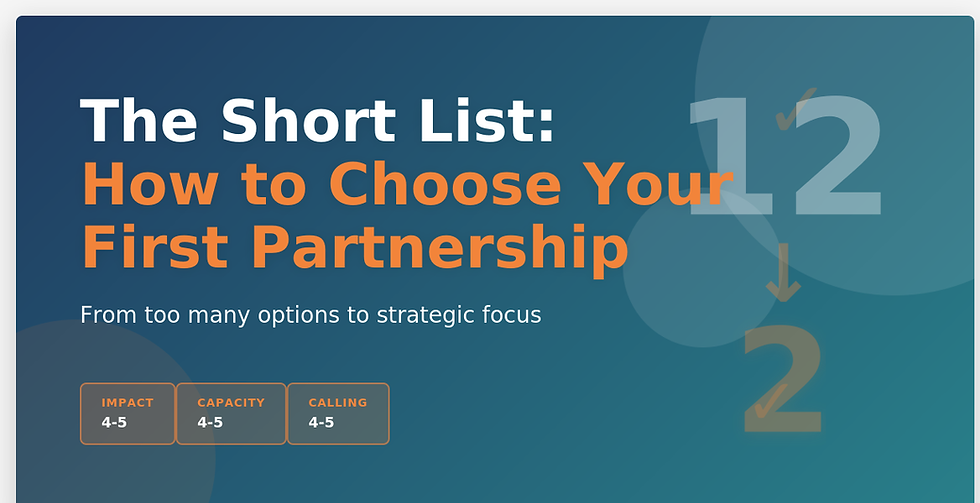
Let me show you the framework that helps churches move from "too many options" to "strategic focus."
______________________________________________________________________________
The Problem with Saying Yes to Everything
Churches often make the same mistake: they complete their assessment, identify needs, then announce "We're launching outreach in all these areas!" Within 6-12 months, many partnerships are struggling. Why? Because good intentions don't create sustainable ministry. Strategy does. You need a framework for choosing which partnerships to pursue first—and which to delay.
______________________________________________________________________________
The Three-Question Framework
Every potential partnership should answer three questions—and score high on all three:
1. Impact: Will this create meaningful transformation?2. Capacity: Can we sustain this with excellence long-term?3. Calling: Does this align with God's unique direction for our church?
Not two out of three. All three. Let me break down each one.
Question 1: Impact
Will this partnership create meaningful transformation in people's lives?
Not: "Is this a good cause?" But: "Will this actually change lives in measurable ways?"
High-impact partnerships have:
Clear, measurable outcomes
Direct contact with people being served
Transformation, not just transactions
Low-impact partnerships involve:
Financial support with minimal relationship
One-time events with no follow-up
Addressing symptoms without root causes
A school with 200 ESL students where you provide weekly tutoring? High impact. A nonprofit gala where you sponsor a table? Important, but lower impact. Ask: What will be different in people's lives? Can we measure it? Does our unique contribution matter?
Question 2: Capacity
Can we sustain this partnership with excellence for at least two years? This is where churches get brutally honest about resources. You might have 500 people in your congregation. But how many are available to volunteer consistently? Be realistic.
Capacity assessment includes:
Volunteer availability: Do you have enough people willing to commit long-term?
Leadership bandwidth: Who will coordinate? Do they have margin?
Financial resources: Do you have budget for this?
Systems: Can you recruit, train, schedule, and support volunteers?
The filter: If a partnership requires more than 15% of your volunteer capacity, leadership from someone already maxed out, budget you don't have, or systems you haven't built—don't start it yet. Wait until you have capacity or build capacity first.
The brutal truth: It's better to decline a great partnership than to commit and fail. Failed partnerships damage your church's reputation and hurt the people you intended to serve.
Question 3: Calling
Does this align with God's unique direction for our church? This is the most spiritual—and most neglected—filter. Not every good opportunity is God's opportunity for you. Your church has a specific calling. A unique combination of location, gifts, passions, and capacities that position you to serve certain populations in certain ways. Other churches can serve other needs. But some needs are particularly aligned with who God has called you to be.
Calling assessment asks:
Passions: What do your people naturally care about? Kids? Seniors? Poverty? Education? Justice?
Unique gifts: What does your church have that others don't? Teachers? Business professionals? Bilingual members? Trade skills?
Context: Does this fit your neighborhood and proximity strategy?
Leadership conviction: Do pastors and leaders feel God's leading toward this?
Divine appointment: Has God opened this door, or are you forcing it?
Before Nehemiah rebuilt Jerusalem's wall, he spent days in prayer (Nehemiah 1:4). Before Paul chose missionary destinations, he sought God's direction and followed where the Spirit led (Acts 16:6-10). Strategic planning isn't opposed to prayer—it requires it.
______________________________________________________________________________
Making the Short List
Here's how to use this framework:
Step 1: List all potential partnerships
Write down every legitimate opportunity you've identified. Don't evaluate yet. Just list them all.
Step 2: Score each partnership
Use a simple 1-5 scale for each question:
Impact: Will this create meaningful transformation? (1=low, 5=high)
Capacity: Can we sustain this with excellence for 2+ years? (1=no way, 5=absolutely)
Calling: Does this align with God's unique direction for us? (1=maybe, 5=clearly yes)
Be honest. Don't inflate scores because you like the idea.
Step 3: Eliminate anything scoring below 4 on any category
This is critical. If a partnership scores a 5 on impact but a 2 on capacity, it's not ready yet. If it scores a 5 on capacity but a 3 on calling, it's not right for you (though it might be perfect for another church). You're looking for partnerships that score 4-5 on all three.
Step 4: Narrow to 1-6 partnerships maximum
Yes, maximum.
Small churches (under 200): Choose 1-2 partnershipsMedium churches (200-500): Choose 2-4 partnershipsLarge churches (500+): Choose 4-6 partnerships
Start small. Do it with excellence. Add more later.
Step 5: Commit for at least one year
Don't launch a partnership if you're not willing to commit for a minimum of 12 months. Community partners need to know you'll show up consistently.
______________________________________________________________________________
What This Looks Like in Practice
A church I worked with started with 14 potential partnerships. They scored each using the three questions.
High scorers (4-5 on all three):
Elementary school ESL tutoring (Impact: 5, Capacity: 5, Calling: 5)
Senior center transportation (Impact: 4, Capacity: 4, Calling: 5)
Eliminated (scored below 4 on at least one category):
Food pantry (5 churches already serving there—low calling score)
Homeless shelter (needed 20 volunteers, only had 8—low capacity)
Job training (required expertise they didn't have—low capacity)
They chose 2 partnerships. Everything else became "not yet."
The Results
Eighteen months later, both partnerships thrived:
Elementary School: 12 consistent tutors, 76% reading improvement, principal invited additional partnerships, families visited church
Senior Center: 8 volunteers for transportation, 20+ seniors in weekly programs, expanded to home repairs, strong community relationships
Why these succeeded: Strategic choice (high scores), focused resources (2 not 14), consistent presence, measurable impact, deep relationships.
Focus created excellence. Excellence created impact.
______________________________________________________________________________
The Freedom of Focus
Narrowing your list doesn't feel limiting—it feels freeing. Too many partnerships means constantly scrambling for volunteers, managing crises, and feeling guilty. Focused partnerships mean deep investment, consistent presence, measurable impact, and sustained momentum.
Excellence at sustainable scale beats scattered effort every time.
______________________________________________________________________________
The Partnerships You're Not Choosing
One final word about the partnerships you're saying "not yet" to:
You're not saying they're unimportant. You're not saying no one should serve there. You're saying it's not the right fit for your church right now. And that's okay.
Other churches can serve those needs. Other organizations are already addressing them. Your job isn't to meet every need in your community—it's to faithfully steward the specific calling God has given you.
Faithful stewardship means strategic focus, not exhaustive coverage.
The Apostle Paul was strategic about where he planted churches. He targeted influential cities and trade routes. He focused on areas where Christ hadn't been named. He didn't try to be everywhere at once. That wasn't lack of compassion. That was strategic thinking submitted to God's direction.
______________________________________________________________________________
Make Your Short List
Pull out your partnership list.
Score each one (1-5 scale):
Impact: Will this create transformation?
Capacity: Can we sustain it for 2+ years?
Calling: Does this align with God's direction?
Eliminate anything below 4 on any category. Narrow to 1-3. Commit for 12 months.
Your community doesn't need your church to do everything. They need you to do something with excellence, consistency, and love.
Focus creates impact.
Not because scattered effort doesn't matter, but because sustained excellence in a few areas creates more Kingdom impact than divided attention across many. Make your short list. Choose strategically. Commit fully. Watch what God does when you stop trying to do everything and start doing the right things with excellence.
__________________________________________________________________________________
Take Action:
Download our "Partnership Evaluation Scorecard" at Partnership Evaluation Scorecard | Outreach Answers. Use it to:
Score each potential partnership on impact, capacity, and calling (1-5 scale)
Eliminate partnerships scoring below 4 on any category
Identify your top 1-6 partnerships
Create a 12-month commitment plan
Build your launch timeline
The best time to get strategic about partnerships was six months ago. The second-best time is today. Make your short list. Launch with focus. Serve with excellence.
__________________________________________________________________________________
Next week: "The Retired Teacher Nobody Knew About (Until We Asked)". Why you need a systematic discovery of assets within your church congregation.


Comments