


Guest Post: A Senior Pastor's View on Why Community Outreach Matters

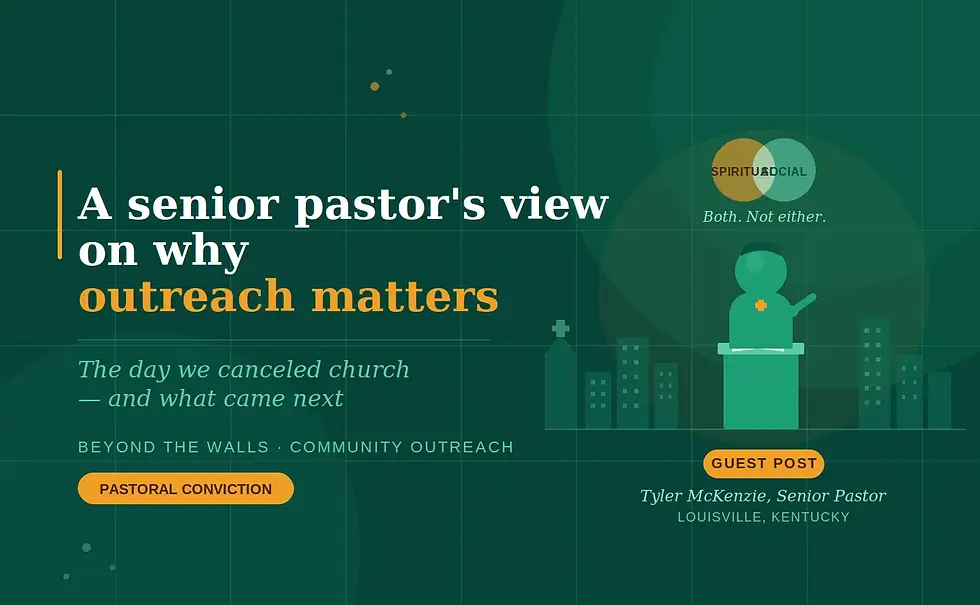
Every week I write about community outreach from the practitioner's perspective — the coordinator, the volunteer, the staff member leading the work. This week, I’m handing the microphone to a senior pastor whose church has done this work for over a decade. Tyler McKenzie is the Lead Pastor at Northeast Christian Church in Louisville, Kentucky — a church that eventually became known as "The Love the 'Ville Church." What follows is a lightly adapted version of his foreword to the book this blog series is built around. If you've ever wondered what pastoral conviction behind community outreach sounds like — this is it.
By Tyler McKenzie
In 2014, we decided to cancel church.
Well, sort of. Our leadership had a strong sense that the Sunday morning gathering had become the totality of who we were. It's not that investing in the gathering is bad. It's just that almost all our energy and resources were flowing into this one hour.
To our team's credit, we were good at these gatherings. They were hospitable, relevant, dynamic, and hope filled. The arts were beautiful. The preaching was powerful. The people were engaged. It was our evangelism strategy “Invest and Invite" — and for years it worked.
But our leadership felt a growing sense that our momentum was slowing and, more importantly, something was missing. Our church needed a heart for local justice and outreach outside of the gathering. We had a mission budget, but it wasn't all that big, and most of the dollars flowed overseas. We were giving very little attention to the real needs of our city — which, ironically, is the actual mission field God had put us on.
We needed a mindset shift. Louisville, Kentucky may not be a developing country. But it was ours. God put us here in this time and place for a reason.
Louisville Is Not Spiritually Neutral
In Louisville, pretty much everyone has heard of Christianity. There are no unreached people groups here in the Bible Belt. Church is part of the unspoken cultural consciousness. The reason people weren't coming to church wasn't because they had never heard of it. It was because their experience with Christianity left them apathetic at best — or downright wounded at worst.
When people outside the church think about church, they think of something. Often, it's not good. Church is not an emotionally neutral topic. People have stories. They have ideas. They have experiences.
We thought: What if we could change these negative associations? What if we became the church known in our city for how and who we love? What if that became our brand distinctive — "At Northeast, they love people, especially the poor, especially children, especially non-Christians — the least, the lost, and the littles"?
We needed to do something bold to get our people's attention. We wanted to awaken our church to a new vision — a vision to become a church for our city. We wanted to earn for ourselves a reputation in Louisville as "The Love the 'Ville Church."
The Day We Canceled Church
So, on a random May Sunday in 2014, we canceled our regularly scheduled services onsite and took church to the streets.
We mobilized 2,000 people that day to serve our community in a variety of practical ways. In the weeks prior, we went door to door to figure out what the community needed. We didn't want to make assumptions. We asked local government officials, nonprofits, business owners, school leaders, and even bartenders. (If you really want to know who in your neighborhood is struggling, ask the local bartender. I promise they will have a few names.)
The day was incredible. The weather was beautiful. The work was meaningful. And the Spirit of God lit a fire in our church that day. After serving, our most popular response from our people was, "When are we doing this again?"
So, we came back in 2015 and did a whole summer of serve days and serve projects. That year, in December of 2015, we decided to collect our first Christmas Eve offering. The pitch was simple: clearly God was blessing our outreach efforts, so whatever was given to this Christmas Eve offering would go toward that.
Our church gave $230,197 that Christmas. We were blown away.
What Can Happen in a Decade
Fast forward from December 2015 to today. We could have never imagined how that vision of becoming The Love the 'Ville Church would come to life over the next decade. We just collected our eleventh Christmas Eve offering to fund our "next ten" years of Love the 'Ville ministry.
Every year, the offering has grown and so has our impact. This year, the church gave just shy of $5.4 million dollars.
Yeah. Not a misprint. Only God.
We now have six amazing outreach staff who are leading our efforts to redefine church around the love of Jesus. One of them is Kris Eldridge, who joined our team in 2022 and whose insights fill this blog series week after week. Kris came with decades of experience and a strategic mind unlike few pastors I've met. I remember when we hired him thinking, "How in the world are we landing guys like this on our team?"
Only God.
I'm a firm believer that leaders like Kris have been the catalyst to Love the 'Ville's recent fruit. The ability to articulate clearly and practically what it takes to establish and grow an outreach culture in your church is priceless.
The Theology Underneath
Why does this matter so much to me pastorally? Here's the conviction I keep returning to.
Jesus gave special attention to two groups of people — the Spiritually Lost and the Socially Least.
His kingdom established Spiritual Justice for the lost (giving sinners what they don't deserve — grace and forgiveness) and Social Justice for the least (giving the least what they do deserve — love and dignity).
This is why when he heals people of physical sickness, he also forgives their sins. There is a social healing and a spiritual healing. This is why he tells parables like the lost sheep, coin, and son, but then also parables like the sheep and the goats in Matthew 25. This is why his first public sermon is Luke 4:18-19 — but then his last sermon before the Ascension is Acts 1:7-8.
There is attention to justice and evangelism. There is attention to the least and the lost.
And here is what I have found: Spiritual Justice fuels Social Justice, and Social Justice fuels Spiritual Justice.
As we build churches concerned with loving the city, our evangelism becomes more compelling and potent. As we evangelize, we see people resurrected to unleash Jesus' love. The two aren't competitors. They aren't trade-offs. They are two sides of the same gospel.
May you see both in your church.
A Word to the Pastor Reading This
If you're a senior pastor reading this and you're wondering whether community outreach is worth the strategic risk of elevating it in your church — let me just say what I wish someone had said to me more directly before 2014.
It is worth it.
Not because it will grow your church (though it might). Not because it will bring in revenue (though for us it clearly has). Not because it will polish your brand (though your reputation in the city will shift).
It is worth it because it is what Jesus actually did. He didn't just preach. He touched. He fed. He healed. He went where the suffering was. He went to the people the religious system had written off.
Our churches are called to the same work. The cost of elevating outreach is real. The resistance you'll face is real. The bandwidth questions are real. All of that is true. But the alternative — a church whose entire identity collapses into one hour on Sunday morning — is not what we were called to build.
Cancel church. Even just once. See what happens.
Tyler McKenzie is the Lead Pastor at Northeast Christian Church in Louisville, Kentucky.
If this resonated with you, share it with your pastor. Not as a demand. Not as a critique of what your church isn't yet doing. Just as a window into what one pastor who has walked this road has learned — and how deep his theological conviction runs. Sometimes the most powerful thing we can give the leader we serve under is another pastor's honest voice.
Forward this post. Then ask if they'd like to talk about it.
Next week: "When Staff and Volunteers Clash: Navigating Church Politics" — the internal conflict dynamics that quietly undermine outreach ministries, and how to build unity across the differences.


Comments